Archive for the ‘Context’ category

Hyperlinks and life

July 8, 2008

I’ve wanted to write about this for some time now. The world that exists now did not exist several years ago – both in terms of time and in relation to global mentality. Where we once saw life itself as a line within time, we now see life as a multi-layered experience sandwiched inside of other multi-layered experiences within the hologram of Life.

In any given day you will see hundreds of “hyperlinks” on your computer screen. These “hyperlinks” will take you on a journey to another website and another context based on one word. You can continue to follow “hyperlinks” and end up in an entirely different train of thought than you began with. Years ago this would not only have been impossible, but also frustrating.

We are in the middle of a transformation from living “sequential” to living “holistic”. Where we were once happy to have “just the facts” we now want backgrounds and profiles and histories so that we can see the “whole” problem, person or situation.

This switch in perceived needs is changing the development of the next generations mind structure from an old sequential, rational, linear, left brain approach to an abstract, intuitive, holistic, right brain approach to living.

We can see this in many areas of our world, but none more significant than media.  Both in web, print and video we no longer have just “one thing” to look at and understand. Each advertisement, show, special or informative bit has multiple streams that we can connect and disconnect with at whim. I can watch a show or sports game and simultaneously know scores from other games and highlights of news pertaining to all sports…and if the news is big enough, global events – as they happen in real time.

This has to change the way we connect with one another and the way we perceive real connection in our lives. The way we choose to interact with this new perception will also dramatically effect both our perceived and actual influence in this world.
Independence Day

July 4, 2008

It’s the fourth again, and with that comes some different kind of feelings around our country. For some they immediately think of the wars going on and have either a positive or negative reaction. For others there is a sense of patriotism – the flag, belonging etc.

Today, I can’t say that any of those emotions have “grabbed” me, yet. I haven’t seen any parades or lit any fireworks, but a sense of interdependence rather than Independence is what has me now.

I am more connected to the space around me now than ever before. That sense of connectedness probably has to do with the talk I’ll deliver Sunday on Awareness, but I hope it will last longer and continue further than Sunday.

To release Independence and individuality and “I’ll do it my own way” to interdependence on the Central Force of the Universe and simply allow myself to flow with the waves of creative energy – not striving against it or pushing it forward brings with it a renewed freedom. Not an easy thing to do either. There is the constant tug to control things and “do” what I’m expected to “do”. However, when we allow our “need to be in control” ego’s to sink and our true self to rise to the surface. We come to the surface with a new vision – a new way of “seeing”.

I don’t want to go to far into what some would call “never, never land”, but the best way I can describe it is the way movie companies have remastered old films. They show the old and new versions side by side and the new version shows more color, clarity and details. That’s what happens when we become “Aware” of the world around us and really “see” with new eyes. One thing is for certain, once you have seen things in their renewed brilliance, you don’t want to go back.

Stroke of Insight

July 2, 2008

I’ve seen this book, but really didn’t think it would interest me. This week I watched a video from the TED conference in Monterrey, California and it was amazing. Though you guys might want to see it as well.

Vodpod videos no longer available.

If it doesn’t play click here

more about “Jill Bolte Taylor’s powerful stroke o…“, posted with vodpod

Emotion – Good or Bad?

June 30, 2008

This is a question that I’ve been asked lately. The core is whether to suppress emotion because it’s bad or lean to channel it in a right way. A lot can be said about emotions, but in the spirit of brief blogging I’ll get straight to the point.

Emotions are distinctly attached to what DeMello calls the “me” (not to be confused with the “I”) “Me” is the ego apparatus that we construct throughout our lives and to a great extent find attachment to. Emotions can cause a problematic swing when left unobserved, but can, when observed lead us to great insight about ourselves and the way we interact with people.

That said, the intent of emotion is an amplification of a feeling. Some feelings like fear, greed and envy are symptoms of a need for control. In this case emotions act as a warning sign to deeper areas needing attention.

Emotion, however, can be useful in bringing some people across the chasm of their doubts and fears. It is only then that some people can detach and observe their life and begin to “see” things as they really are. They begin to understand that many of their problems are either illusions or created by themselves.

Socrates said, “The unexamined life is not worth living.” When we live an unobserved life we allow the script of our lives to be written by others, discussed by others and edited by others. Only when we choose to “watch” the actions of our lives can we hope to “have life and have it more abundantly.”

When Balance isn’t really Balance

June 27, 2008

I’ve written quite a bit about the importance of being balanced. I feel that to find success in any area of life, balance must be a part of the equation. But what kind of balance? Sometimes I can sit outside or take a day off or go somewhere else and feel like I have found balance. I can begin to hear my internal dialogue and interior silence grow. I can even have  the beginnings of an enraptured feeling where I think I have it “all figured out”.

Is what I’m feeling true or not? You’ve probably experienced this before and wondered the same thing. I think that the only way we know if we are in balance is to be in balance in the regular rhythms of life.

Moments of self-discovery are essential, but can actually be detrimental if we lead a life hopping from one of those moments to another. Everything in life is balanced on the pivot of “now”. I have no control over event in the recent or far past; neither do I have any control over things yet to happen. The only place that I have any ability to “do” anything is right here, right now.

If the only way I can feel “in balance” is to escape living life in community, I have become severely off balance in both perspective and execution of life.

John Maeda is becoming a mentor-at-large. He had a conversation with a colleague about insecurity. And I think it has great significance on the idea of real balance. He said, “The thing about insecurity, is that if you are too insecure, then you don’t grow – because you’re paralyzed by fear of failure. On the other hand, if you have no insecurity, then you don’t grow either – because your head is so big you can’t recognize your failures.” The colleague replied, “Balance in all.” John continued, “If you are in the middle, however, you have to shift towards the edges and oscillate a bit in order to know if you are centered.” He responded, “You can get lost in the middle. You need mentors to give you courage.”

To this John questioned, “But all your mentors tend to go away as you age.” The answer, “Yes, because you don’t need them anymore.”

The key is to embrace the oscillation around center/balance, always checking that the pendulum doesn’t swing too far in any direction.

Reduction

June 25, 2008

I’m loving the book, “The Art of Simplicity” by John Maeda. The first sentence of the book says, “The easiest way to simplify a system is to remove functionality.” He goes on to use the DVD player as an example. We really only need one button – play, but there are some who would like more, maybe to go back or go forward, still others would like more features.

The balance between simplicity and complexity is the basic question. How simple can it be and how complex does it have to be?

“The simplest way to achieve simplicity is through thoughtful reduction.” When you remove something, just think about it before you do it.

I am thinking about this in terms of life and church. How do we balance simplicity and complexity in those venues? Last week I wrote about the struggle between personal and professional vision. If we continue to add and add more and more we will soon drown in our own “vision”. There has to be a give and take if we are to “thoughtfully reduce”. This concept of reduction is John’s first of ten laws dealing with issues related to simplicity.

I leave you with one more thought coming from page two. When faced with the need to reduce we have to deal with the problem of deciding what lives and what dies. John says that these decisions do not come easy to us because we are not trained to be despots. Our default is to let what is living live. Inevitably we would allow all functionality to stay if we could.

First Week of One Prayer

June 22, 2008

Lifepoint is a wonderful place. Can I say it again? Lifepoint is a wonderful place. The first week of One Prayer was great. Hearing from someone else and matrixing their point of view with our own has a magical quality about it. Sometimes a whole new perspective is gleaned. Sometimes when we hear something from a third party it carries more weight and we respond better. Think about (if you have kids) when you have told your child to do something and their response was let’s say…lacking.

Now think of times when the same words that come out of your mouth, came out of another adult’s mouth and your children reacted as though that were the first time they had ever heard those words. Same thing when hearing from someone somewhere else. We listen with different ears, and the results can be amazing.

We accomplished the change in the set by using a stencil of one of the One Prayer logos. The effect on the floor was done by using a gloss paint over a flat of the same color.

One of the things I loved about this morning was the baptisms. They have to be my favorite aspect of displayed Christianity. It is such a visceral moment to watch someone you know be baptized. I’m so very grateful to be part of the large story God is telling through the lives and events at Lifepoint.

Can’t wait until next week! I’ll tell you more about what’s coming up later in the week.

Insultants

June 14, 2008

Last week I read a book in which a key way to produce action and innovation within an organization is to activate “insultants”. I have to admit, at first I thought he was talking about having people who are free enough to tell you, the leader, the hard things and in fact, insult you. I was wrong.

The author used a different point of view on the idea of “consultants”. Typically consultants originate outside of an organization. They provide valuable insight because they are outsiders, however, that same reason – coming from the outside – blinds consultants from culture nuances and unsaid generally accepted protocols unique to different businesses.

The suggestion of “insultants” – consultants from within the business structure – is a great idea that has implications far beyond work environments. By giving some a responsibility to become aware and constructively question practices and actions, a wealth of information can be gleaned.

We can turn this practice to our own lives. If we do not have someone who knows our quirks and also has the freedom to tell us when we vear close to or cross the line, we should look at our relationship account and consider it lacking and in the red. The most valuable asset we can have are people who can constructively view our lives through the “who we are now” while looking toward the “who we want to be” and help us to get there.

If you don’t have a personal “insultant” hire one and you’ll be amazed at the difference a shift in perspective and a new voice can make.

Rich Mullins

June 12, 2008

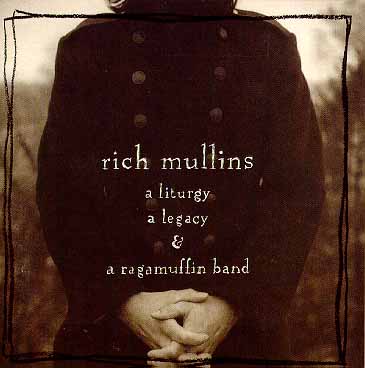
Do you ever find things on your iPod that surprise you? Apparently I had put Rich Mullins’ album A Liturgy, A Legacy & A Ragamuffin Bandin my playlist. So I decided to take a listen. Now the album is a number of years old and has a decidedly early 90’s Christian music folk sound, but…it floored me.

There I am sitting in the car and my eyes are welling up and emotions are bombarding me and the freshness of Rich’s delivery and lyrics has taken over. I heard “Hold Me Jesus” like it was the first time I had ever heard it.

Perhaps it was the first time I really heard what Rich was trying to say in those words. Whatever the case I had to pull into Barnes & Nobles and get out of the car to pull myself together. Emotions are such powerful things. They can be allies or adversaries.

I am thankful that my day was invaded by the late Rich Mullins. A liturgy is a path to God’s presence; a legacy is something that lives on after we are gone. I’d say Rich’s album title was prophetic and true – at least today, long after Rich’s too early passing, it brought me to God’s presence, and let me know Him just a little more.

Real Success

June 10, 2008

I’m a quote guy. I love quotes. In fact, I think quotes are better than just rattling off some thought or idea because they have come out of someone else’s mouth. How many times, parents, have you told and retold your child something only to have them come back after hearing the same thing from another individual…and doing it.

Somehow hearing things from outside our normal “tribe” gives the words more meaning. David McCullough says that “real success is finding your lifework in the work that you love.”

When you have found a way to do something you love and get paid doing it, you have found true success. Look at your situation right now and ask the hard question, “Do I love, really love what I’m doing?” “Is what I’m doing something I would do even if I didn’t receive a paycheck?”

The answers to those questions will reveal the reality of your situation. It may be that you are not where you want to be. If you are young, you have time to find what really gives you joy. If you are older, you know what gives you joy, but it may not be the same thing you are employed to do.

Re-evaluation is key in all of the processes of life. Culture and time move on and we must adjust to remain relevant and able to contribute. Ask the hard questions and resolve to put action behind the answers. As Rob Schneider says in every Adam Sandler movie, “You can do it!”