Archive for the ‘Context’ category

Good Lord

January 25, 2008

caesar.jpg

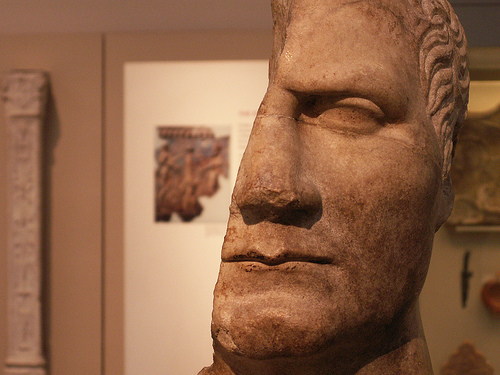
There is more to God being in charge than just Jesus sitting on a throne. It is true that He is the Magnificent King, but what did it mean then – when it was written? To say “Lord”, was a political statement. One for a deity[Jesus] and against Caesar, the accepted deity of the time, who also happened to be king and supreme ruler. When the followers of Jesus proclaimed that he was “Lord”, they were tempting fate and their future as living people. To go against Caesar was to put your life in jeopardy.

An interesting side note is that Jesus says, that not all those who say “Lord, Lord” will enter into the Kingdom [there it is again]. In essence saying that those who put themselves at personal risk by aligning with Jesus aren’t guaranteed a free pass. This idea makes the concept of The Kingdom even a greater one that needs discovery. It in fact makes The Kingdom….greater.

Everything Is Beautiful !?!

January 22, 2008

salon-of-beauty.jpg

Have you ever had someone come up to you and you see that they are beaming with happiness and it ticks you off? They have met you in a moment where you were reveling in your own disgust with the world. You were happy being sad and frustrated, but they came anyway. A perfectly great opportunity to wallow in self-pity has been ruined.

Maybe it’s just me, but during those times of personal loathing of everything around me, the last thing I want to see is someone actually happy – and not just happy, really full of joy – beaming in the beauty of everything that is.

I thought I had it nailed down. I would quote the “everything has a season to mourn and cry…yada yada, yada…”, but I saw something that struck me as odd. Odd because we tend to have scriptures we quote almost out of habit. This time I found out I had been wrong.

Ecclesiasties 3:11 – “He has made everything beautiful, in its time.” How is it that I had missed that for soooo long? What are the real implications to this? Could it be that even those things that I don’t want to experience are beautiful at some point? I think so. When I look at my life, the moments that have become “beautiful” have been those that were, at the time, the most difficult to walk through. It was because of their hardness that they were able to etch out a part of me. Though excruciating at the time, the result was – I have to say it – Beautiful.

Isaiah 52 says, “How beautiful….are the feet of those who bring good news.”  I wonder if the pain that sometimes comes from “bringing the good news” often result in beauty, but that beauty is left unseen.  Today, look at those things that have brought pain, and view them with new eyes and instead of pain see the beauty.

C. S. Lewis

January 20, 2008

the-last-battle.jpg

Found this quote and thought it fit great with the previous post – it’s long but poignant

“In a narrow place between two rocks there came to meet me a great Lion.  The speed of himwas like the ostrich, and his size was an elephant’s; his hair was like pure gold and the brightness of his eeyes, like gold that is liquid in the furnace….In beauty he surpassed all that is in the world, even as the rose in bloom surpasses the dust of the desert. Then I fell at his feet and thought, Surely this is the hour of death, for the Lion (who is worthy of all honor) will know that I have served tash all my days and not him. Nevertheless, it is better to see the Lion and die than to be [king] of the world and live and not to have seen him. But the Glorious One bent down and touched my forehead with his tongue and said, Son, thou art welcome. But i said, Alas, Lord, I am no son of Thine but the servant of Tash. He answered, Child, all the service thou hast done to Tash, I account as service done to me. Then by reason of my great desire for wisdom and understanding, I overcame my fear and questioned the Glorious One and said, “Lord is it then true, as the Ape said, that thou and tash are one?” The Lion growled so that the earth shook (but his wrath was not against me) and said, It is false. Not because he and I are one, but because we are opposites, I take to me the services which thou hast done to him, for I and he are of such different kinds that no service which is vile can be done to me, and none which is not vile can be done to him. Therefore if any man swear by Tash and keep his oath for the oath’s sake, it is by me that he has truly sworn, though he know it not, and it it I who reward him. And if any man do cruelty in my name, then though he says the name Aslan, it is tash whom he serves and by Tash his deed accepted. Dost thou understand, Child? I said, Lord, thou knowest how much I understand. But I said also (for the truth constrained me), Yes I have been seeking Tash all my days. Beloved, said the Glorious One, unless thy desire had been for me thou wouldst not have sought so long and truly. For all find what they truly seek.” 

from C. S. Lewis, The Last Battle pp. 164-165
What is the Kingdom?

January 17, 2008

No way am I going to try to completly answer this question. I just want to add some thoughts to it. When we discuss “the Kingdom”, what are we really talking about? Christians tend to talk about heaven and the after-life when the topic of the Kingdom is brought up. I’m not going to necessarily object to that, but I do thing there is more to it.

Again, pages and pages could be devoted to this issue alone, but there is a concern that I have. What if we have missed a central area and traded it for a fringe theory? I believe that the calling we have been asked for by Christ consumes much more than just the after-life. I think it is also more than just getting people ready to go to heaven.

Many of our modernistic approaches to Christianity cannot be found in Scripture. We give altar calls, but Jesus didn’t; we tell people they have to go to church, but Jesus didn’t; we tell people things they have to do and stop doing to be able to follow Jesus, but He didn’t.

I’m firm in my thought that there is much more to the Kingdom of God than we have allowed to “meet out eyes”.

Exponential Impact

January 12, 2008

I’ve talked a lot about the difference between the singular and pluralistic feel some in the spiritual community have. Some are self oriented (singular) in their approach and practice of religion and spirituality. On the other hand, some are “others” focused (plural) in their view of life and its experience. My view is that we look at what happens to us as we live our lives.

When an event occurs in our life and we respond to it, our influence on others has an “addition” effect. We tell someone to our left or to our right or both. In that example now 2 or 3 people know of the event. This is how many view spirituality. “Go tell” is what we have been programed. We need to “add more people to the fold” kind of talk.

Realistically, the knowledge of the event travels additionally and exponentially. You tell a few, who tell a few, who tell a few, and before long everybody has heard some version of the original story.

 We need to live with an exponential view of life. We should understand that our actions and words have the exponential effect of ripples in a pond. This is an enormous ability for the positive and the negative. Let us live our lives to exponentially increase the influence of the positive in our lives and others.

The Environmental Church

January 9, 2008

Much has been discussed about the environment and the environmental movement. As in any cultural discussion, the church must have a place in the dialogue – in fact the church should be directing the dialogue. So many times the church has been at the back end of scientific discussion. Whether it is because we have an affinity to hold on to outdated comfortable rhetoric or because we have an illusion of power and don’t want to escape that illusion, I do not know, but what I do know is that a conversation has begun and we need to respond.

In the modern era we walked sheepishly behind culture and added comment to it. As things became more and more defined we began to adjust and enjoy being able to disect God in a seminary and teach about Him in detail. As the time changes, this simplistic, cut-and-dry approach is failing to work on everything from light and time to our own perception of these events. Spirituality is no different. Today there is a movement toward a more organic and visceral approach to spirituality. Whether it is called Postmodern or Emerging, the change of direction is apparent.

The church of tomorrow will look and feel distinctly different to the one we have today. There will still be steepled churches that meet the demand of spiritual consumers, but there will also be a new place. I see an environment that embraces both spirituality and mission; a meeting of service and belief. There is no difinitive snapshot of this gathering, it is and will be as maleable as it’s context requires. The key element to expect is a decrease in the individual aspect of experience and a meshing of combined experience.  

Watching Moses

January 7, 2008

I love the Old Testament stories of Moses. He led the children of Israel through many disheartening situations; he delt with revolt and rebellion; but through it all he eventually took them where he had wanted to take them for many years. At the end of his life, he ended up only seeing the Promised Land.

I believe that this could be a parallel to what many in the religious community are experiencing. We have a tendency, at least in America, to consume. We buy things we don’t need because we are told we “need” them, but we know we really don’t have any need or use for them. The same is true for spiritual experience. We have become “spiritual consumers”. We want to feel something or hear something or be given something, but our response, most often, is not to let these things flow out of us to others. By in large we simply consume more; in effect wasting spiritual experience for the sake of self-gratification.

Don’t get me wrong, spiritual experience is wonderful, but if it leads to nothing more than an over active appetite for more of the same, I fear we have missed the point of these experiences. If anything we should walk away from these experiences knowing how much we are all connected in the spirit, not with a singular point of view that amplifies our self view. When we approach the spiritual with an attitude of emptiness in order to be filled, we experience the truth. If we come to experience and then use the experience to lift ourselves, we have made a mistake.

These experiences, if they are true, lead us closer to God. As we near Him we embrace the oneness of spiritual things. When we abandon the self, we embrace our real self. “To live, we must die.” I do not intend to simply watch the great things of God, I intend to be actively involved with them. I hope that you too will desire to truly experience and not simply consume.

who did Jesus love?

December 9, 2007

saint_peter1.jpg

When we talk about Jesus and His relationship with His disciples we often mention that John was the disciple Jesus loved. I think we forget that it was John who was writing those words to begin with and the relationship events that we find in scripture between Jesus and the other disciples.

When we think of Peter we think of an abrupt sometimes rude fellow who puts his foot in his mouth, but I would like us to reconsider. One of the best parts of the Gospels is found in Matthew chapter 16. Jesus goes to His disciples and askes them who people say He is.  Jesus gets positively ecstatic congratulating Peter on knowing “who He is”.

After that Jesus begins to talk to the disciples about His death. I love what happens in verse 22. Peter pulls Jesus aside and basically gets on His case. Look past the conversation that ends with “Get behind me Satan”, and see the unique relationship they both have. Peter feels comfortable enough to speak plainly to the guy that a few moments earlier he has designated as “the Christ, the Son of the living God”.

I am so thankful that Jesus allows Peter in to His “space”. Jesus is not abrasive, but He responds with the same amount of relationship as Peter. The great thing about this interchange is that Jesus doesn’t close Peter off. In fact, He uses Peter to explain the purpose for his death.

All this before the transfiguration.  

The Art of Christianity

December 1, 2007

rembrandt-2.jpg

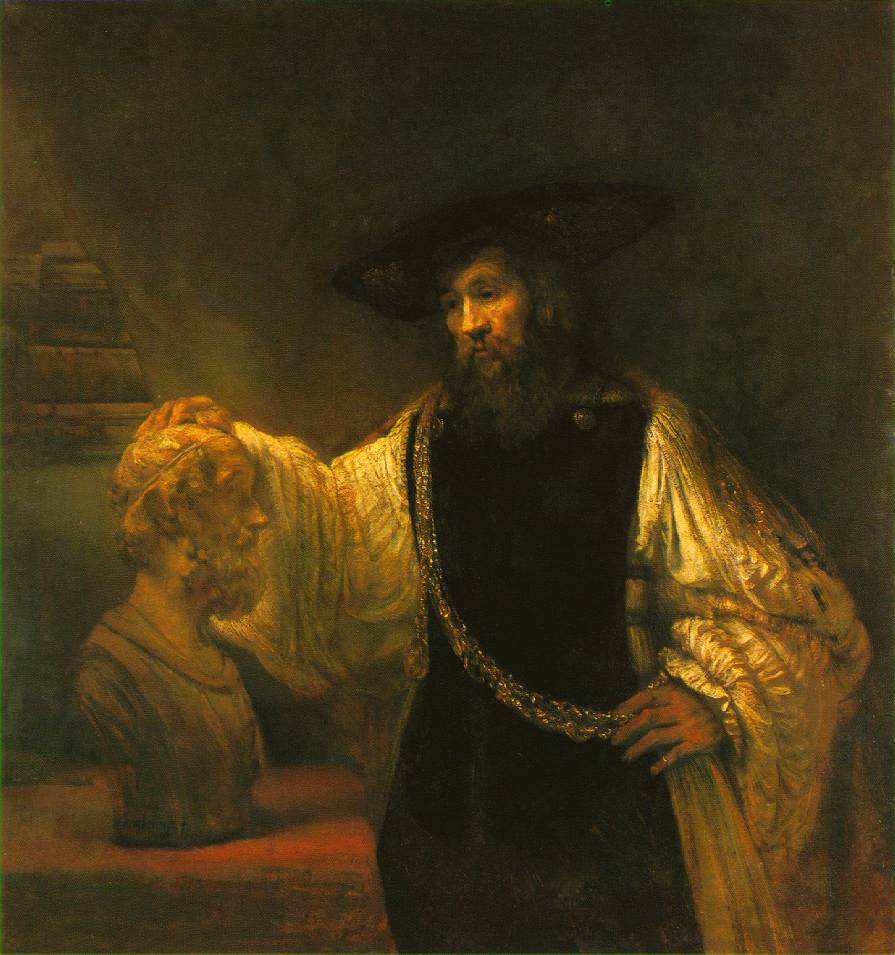
Earlier today, I read an article about the great Masters. It stated that during the time in which their great works were painted, much of what we see in museums was actually painted by their students. The students copied the Master in order to learn the fundamentals about dimension and perspective. Once the student became proficient in their ability to copy the Master, the Master allowed them to hone their own skill set.

Once the fundamentals were in place the student was given the opportunity to explore other ways of creating art.

I can’t help thinking that this applies to us as well. When we follow our Master and study so that our brushstrokes mimic the Master’s, he then steps back and lets us become creative with the story and tell it in new ways. We must always keep the perspective correct, but whether we embrace Realism, Impressionism, Cubism or Modernism the Master looks with favor on the things we create.

Without first being taught by the Master we can never hope to achieve anything, but with the tutelage of the Master we can “do what I have been doing. He will do even greater things than these.”

Messy Spirituality

November 30, 2007

rvfibg_13_common_titledetail_imageloader.gif

A friend of mine reminded me of this book, Messy Spirituality. I had picked it up a few years ago when I was involved in youth work. Yaconelli was known for his “freeness” and in this book does a masterful job at expressing the incredible love of God for His children.

In spite of and probably because of our shortcomings we see that, as the Shack so eloquently put it, He is “fond of us”. So often I wonder if we seclude ourselves into the walls of the church because we are afraid of entering into the world. Could it be because we are afraid of the judgment of others as we enter the world. Could it be that in entering the world we are afraid that we will find that we should have been there all along and have wasted precious moments sitting on the wrong side of a glazed window. 

Is a building really necessary and can it become a hindrance rather than a blessing? Is the cost of upkeep worth the lost community influence through helping the poor and needy? 

I don’t know the answer, and would not presume we should all  sell our land and give to the poor. It simply gives me pause to consider that the areas we are being drawn to serve in are outside the church walls.

Perhaps a new monasticism is emerging. Where once monks secluded themselves inside the church to find God, possibly now monks will seclude themselves outside the church in order to find God.

Maybe a greater portion of spirituality and grace can be seen in the faces of those who choose not to enter the church. Maybe it is outside in the harsh surroundings that we discover the pleasant scent of communion and conversation.