Archive for the ‘Belief’ category

The Audacity of Gratefulness

July 10, 2008

OK, so I “borrowed” an adjective from the popular book, The Audacity of Hope by Barak Obama  (there, got all the copyright stuff out of the way). Today, I am embraced by and seeking to embrace more of a sense of gratefulness. It’s not about a particular place or thing or event, but it is coming from a desire to look beyond “my” world and see the great big world that has been given as a gift to all of us.

In our face daily there are plenty of things that we can “not” be grateful for, but when we bypass our own attachment and look around, there is far more to appreciate and be grateful for. I will go so far as to say the greatest thing we can do to open up the path for us to connect more closely to God is to become more grateful. Think about this today and then go put it into action!

How far?

July 7, 2008

I’ve had this though brewing in my mind about the changes that I see going on in life and around the world. There seems to be a shift in both perception and execution of things. Coming off the heels of Sunday’s talk on Awareness, I’ve been having to answer the question I posed to you guys – “How far are you willing to go?” in regard to becoming Aware.

The ultimate truth is that we are here for a purpose and we are here to live in communal respect with both ourselves (self-respect) and respect to the Creator who put us here to begin with. There is a balance between healthy self-respect based on our existence and feeding Ego with “I am what I do, have, etc.”

I think that this is one of the greatest hindrances we have to overcome as we seek to live and Aware life. Voices from the past creep up and tell us that we are not worthy or not good enough or not “this” or “that”, but the truth is that we are who God, the Source, has created us to be. Certainly we may have made decisions that disappointed family and friends, but those decisions did not shock or surprise God. Let that last sentence sink in a bit.

You are a combination of events and spirit that God knew would collide and form the “you” you are now. Look at yourself and know that you are deserving of respect from yourself and worthy of connecting with the great Power of the Universe.

Once we are able to shake the shame and self-loathing fed by our own Egos, our own light will begin to shine brighter not only to ourselves, but to those around us as well.

When Balance isn’t really Balance

June 27, 2008

I’ve written quite a bit about the importance of being balanced. I feel that to find success in any area of life, balance must be a part of the equation. But what kind of balance? Sometimes I can sit outside or take a day off or go somewhere else and feel like I have found balance. I can begin to hear my internal dialogue and interior silence grow. I can even have  the beginnings of an enraptured feeling where I think I have it “all figured out”.

Is what I’m feeling true or not? You’ve probably experienced this before and wondered the same thing. I think that the only way we know if we are in balance is to be in balance in the regular rhythms of life.

Moments of self-discovery are essential, but can actually be detrimental if we lead a life hopping from one of those moments to another. Everything in life is balanced on the pivot of “now”. I have no control over event in the recent or far past; neither do I have any control over things yet to happen. The only place that I have any ability to “do” anything is right here, right now.

If the only way I can feel “in balance” is to escape living life in community, I have become severely off balance in both perspective and execution of life.

John Maeda is becoming a mentor-at-large. He had a conversation with a colleague about insecurity. And I think it has great significance on the idea of real balance. He said, “The thing about insecurity, is that if you are too insecure, then you don’t grow – because you’re paralyzed by fear of failure. On the other hand, if you have no insecurity, then you don’t grow either – because your head is so big you can’t recognize your failures.” The colleague replied, “Balance in all.” John continued, “If you are in the middle, however, you have to shift towards the edges and oscillate a bit in order to know if you are centered.” He responded, “You can get lost in the middle. You need mentors to give you courage.”

To this John questioned, “But all your mentors tend to go away as you age.” The answer, “Yes, because you don’t need them anymore.”

The key is to embrace the oscillation around center/balance, always checking that the pendulum doesn’t swing too far in any direction.

Reduction

June 25, 2008

I’m loving the book, “The Art of Simplicity” by John Maeda. The first sentence of the book says, “The easiest way to simplify a system is to remove functionality.” He goes on to use the DVD player as an example. We really only need one button – play, but there are some who would like more, maybe to go back or go forward, still others would like more features.

The balance between simplicity and complexity is the basic question. How simple can it be and how complex does it have to be?

“The simplest way to achieve simplicity is through thoughtful reduction.” When you remove something, just think about it before you do it.

I am thinking about this in terms of life and church. How do we balance simplicity and complexity in those venues? Last week I wrote about the struggle between personal and professional vision. If we continue to add and add more and more we will soon drown in our own “vision”. There has to be a give and take if we are to “thoughtfully reduce”. This concept of reduction is John’s first of ten laws dealing with issues related to simplicity.

I leave you with one more thought coming from page two. When faced with the need to reduce we have to deal with the problem of deciding what lives and what dies. John says that these decisions do not come easy to us because we are not trained to be despots. Our default is to let what is living live. Inevitably we would allow all functionality to stay if we could.

Tiger Woods – “Yes He (and We) Can!”

June 24, 2008

OK we’ve seen the great Tiger win and win and win. Some have said he made a mistake to play while injured, I just think he is an animal. Also, for the record, I don’t think he’ll be out the entire season.

Chip Brown went to Florida in March to take a look at the Woods phenomenon. Brown looked at the relationship between Tiger and us, and how Tigers greatness fulfills a need for greatness the many of us have deep in our hearts.

Brown writes, “You’re writing about a relationship, and you’re projecting on to him. It has to do with what we bring to the theater. If we didn’t bring that ache, that hunger to see him prevail, then we wouldn’t find it answered in Woods. It’s an equation.”

“The subject himself is actually fairly mundane, especially when he doesn’t have a golf club in his hand.” He focuses on the fascinating thing that is created between Woods and his admirers.

“The poet David Ignatow wrote about that ‘wild third thing’, that thing that two people make in concert.” Brown says that the thing that drew him was the “strange equation between the champion and those who venerate him.”

“Truthfully, it seems only a matter of time before Tiger will be known as the greatest golfer who has ever lived. We will be watching him, needing him to be exceptional so that we can feel exceptional also. Tiger is that rare champion who can ‘carry us beyond ourselves.'”

Be like Jesus?

June 23, 2008

We all know and believe that Jesus had a purpose when He was born and in His death and resurrection He fulfilled His purpose. What does that mean for us when placed over the desire for us to “know our purpose” and to “be like Jesus”?

No I’m not proposing heresy, but I am asking that we look closer to the words we use. Cliches become cliches because of the truth they contain. However, through time, the words can lose their original meaning. Yes we all have a purpose, but it doesn’t mean we have only “one” purpose. Jesus fulfilled His purpose not by dying and being resurrected. He fulfilled His purpose by “doing what He saw His Father doing”, by divesting Himself of His own ego and allowing Himself to become “no-thing” that He might be used to do “some-thing”.

This is where we find the reality of our “purpose in life”. Our purpose is to have no purpose – only to do our Father’s bidding. To allow Paul’s old man to die, is to be released from the bondage to the egoic self, the false self and to “be” who God desires us to “be”.

Anthony De Mello in conversation

June 18, 2008

In a couple of weeks I’ll be speaking about my One Prayer. I’ll let it out now and say that my One Prayer is that we be Aware. This is a concept that has been a part of my thinking for several years now. One of the books and authors that has had a great impact has been Awareness by Anthony De Mello.

This week a section of the book came up in a conversation with Mike our Executive Pastor here at Lifepoint. I thought I would share this liberating section with you.

“The great Socrates said, ‘The unaware life is not worth living.’ That’s a self-evident truth. Most people don’t live aware lives. They live mechanical lives…’My that’s a lovely shirt.’ You feel good hearing that. For a shirt for heaven’s sake! You feel proud of yourself when you hear that. People come over to my center in India and they say, ‘What a lovely place, these lovely trees’ (for which I’m not responsible at all), ‘this lovely climate.’ And already I’m feeling good, until I catch myself feeling good, and I say, ‘Hey, can you imagine anything as stupid as that?’ I’m not responsible for those trees; I wasn’t responsible for choosing the location. I didn’t order the weather; it just happened. But “me got in there, so I’m feeling good about “my” culture and “my” nation. How stupid can you get?….Indian culture has produced great mystics. I didn’t produce them. I’m not responsible for them. They tell me, ‘ That country of yours and it’s poverty – it’s disgusting.’ I feel ashamed. But I didn’t create it. What’s going on? Did you ever start to think? People say, ‘I think you’re charming’, so I feel wonderful. I get a positive stroke …I’m going to write a book someday and the title will be . “I’m an Ass, You’re an Ass”. That’s the most liberating, wonderful thing in the world, when you openly admit you’re an ass. It’s wonderful. When people tell me, ‘You’re wrong.’ I say, ‘What can you expect of an ass?”

Hope this helped to lighten your load as much as it did mine!

Are we acting?

June 9, 2008

Johnny Depp has proven himself time and time again as a great actor. His ability to invest himself into a part and “become” the character he has been asked to play is a credit to his talent, preparation and quest for more than just “playing a part”.

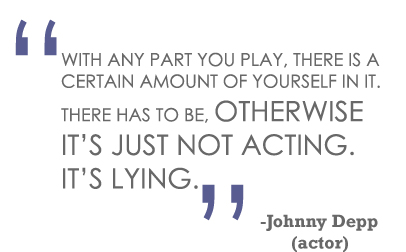
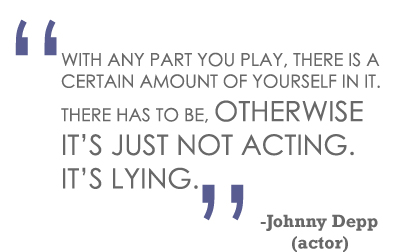
He is quoted as saying, “With any part you play, there is a certain amount of yourself in it. There has to be, otherwise it’s just not acting. It’s lying.”

We all have people in our lives who require a different context for our interaction with them. We are different with family than we are with business associates; we modify our language around customers as opposed to co-workers. Throughout our lives we shift in different modes when faced with different situations and different people.

We must maintain ourselves in those transitions. Authenticity is not defined by the minute actions and information exchanged, it is defined by the inner force behind those actions. People know when we are faking. Not because the don’t believe the words we are saying, but because they don’t believe the “we” that are saying them.

When we don’t believe what we say we mutiny against ourselves. Subliminal sabotage results as we embark in conversations, relationships or proposals that we are not confidently secure in at the onset.

When Paul spoke of being “all things to all people”, methods and decorum were the items that changed, not the authenticity of the message. Center yourself around your message, only when you believe it will you have any chance of securing belief from others.

Re-invention

June 4, 2008

One of the things that successful organizations have to always keep before them is the value of, what I call, Thinking Forward.  While it is important to have your focus on the Now, it is also just as important to look ahead. In fact, one of the keys to Lifepoint’s continued relevance is it’s ability to review current culture and point out where the church can best impact the local community of Byron and Peach and Houston Counties.

To let you in on some thinking and how far we allow brainstorming to go, ask yourself some questions. What can Lifepoint do to positivley impact its locality more than it is currently doing? Don’t just think of adding programs, think deeper to what inner cultural changes can be made…or should anything be changed at all?

We all know that all things green are prevelant in culture, more now than at any other time. What could or should we do as a church to acknowledge this shift in culture?

What about the impact of a black candidate for President? How should or could we work toward racial unity in our local environment? 

What about the increase of Islam as a world religion and its misunderstanding in most conservative southern churches? What should or could we do to motivate a combining of efforts with Islamic, Jewish, Catholic and Protestant faiths to promote a better city and rural life for those around us?

These are not questions that most religious leaders want to listen to or acknowledge, but this is the life we live. These questions and more are on the minds and hearts of Middle Georgians. If we as a church do not seek to cultivate a community that at the very least entertains these questions, we will find ourselves running toward a road that ends with divisional walls separating the “us” from the “them”.

Lifepoint is a different place entirely. We challenge the “us/them” question consistantly. We see Macon in a downward spiral and ask, “What can we do?” We see the increase in gas prices and ask, “What can we do?” We look out and hear the discomfort and unease around us and ask, “What can we do?” But more than just ask the questions, when we have defined a place where we can make a difference, we do something.

No, we do not feed thousands and build hundreds of homes and provide countless jobs, but we do what we can. Often we as individuals look out and feel overwhelmed by the magnitude of problems that surround us. We become paralyzed and still. At Lifepoint we have been there too. Paralyzed and unsure of what action to take.

The difference is that we constantly relook and relook at circumstances to provoke us to do something. We have provided water for those in Africa and shelter for those in Houston County. Is there more to do? Certainly, and because of that don’t be suprised when things change.

The central guiding focus of Lifepoint is to provide an environment where those who do not know God or who have known and left can come and experience a place to grow into faith. It’s OK to not believe in God, or be gay, or have a less than stellar background. We know that the God we serve is large and His love is large. We also know that when allowed to question faith without resistance in a supporting environment, people find a God that loves them way more than they first thought, loves them where they are and walks with them throughout life. 

Re-invention and innovation go hand in hand. For a church to be innovative it must continually be re-inventing itself. Two results follow. One is that the core continues to evolve and change; the other is that new people who once thought that God had no place for them, suddenly find themselves immersed in a community of people set on making a difference one person at a time.

That is Lifepoint.
Stanley Cup Finals

June 2, 2008

Alright guys, I love sports though I don’t look the part. That said, I’ve loved hockey for a long time and have looked on with a bit of question as the sport has gone down in public popularity. But I have to say that tonight was one of the best games I’ve seen.

One of the big qutes I got was “Don’t try to referee the game just play.” How true is that in the way we work in both church and life. If we focus on playing the game and leave the refereeing to the referees, then we focus on doing what we can do – that thing that defines us and gives us a lift when we are DOING it. The second hardest part of life is to find that “thing” that only you do, but the hardest part of life is keeping focused on it.

The Penguins played their heart out and moved past the need to referee and eventually they won the game.