Archive for the ‘Creativity’ category

Debbie Blue – From Stone to Living Word

September 18, 2008

Had to write a little about this book. From the first line – “I’m not good with answers” – the book is immediately accessible. Blue writes openly and confidently as she weaves through some thoughts that many of us have had but found difficult to articulate.

As a pastor, she talks about wishing to be like Father Zossima in The Brother’s Karamazov.

She quotes Eduard Thurneysen speaking about Father Zossima saying:

 “It [his pastoral approach] is not designed to remove [people’s] burdens, to lead them out of the uncertainties of their lives, but it is intended to lead [people] into them truly and for the first time…for in persevering in the uncertainties of life, he sees the only way of redemption.”

She follows that great quote, about a character in a book that you should read if you haven’t, by stating, “I honestly don’t know what it would even quite mean to straighten a life out.


So often we perceive the church as a place to fix things, as God a “fixer”, as life needing to be fixed. Life is meant to be lived fully and that often means it will be messy and loud and unpredictable and wild. When we accept that we are trying to embrace the Unembraceable, know the Unknowable and understand the Incomprehensible, a non-straightened out life seems to be the only kind that would fit.


Oh to let go and embrace nothing, knowing that in that futile attempt you have found what you were looking for. He is unembraceable not because he is far and distant, but because he so permeates every inch of our lives that if we were to contain him, he would cease to be himself. He is “in all, above all and through all”. If we can learn to live within the drawing love of God the Other, our lives themselves will transcend understanding and the chaotic will become beautiful and our view of God himself or herself will expand into an ever increasing undulation of love that desires to overwhelm and overtake us.

Wine….and more wine!

September 17, 2008

In lieu of the comments from Sunday’s message I feel compelled to bring up the story of Jesus and the wedding in Cana. In spite of the church’s need to display Jesus as a party pooper, he was nothing of the sort. Jesus was, in fact, the kind of guy you would want around if you were to throw a party.

Jesus’ ability to turn water into wine, although very handy, is not the reason I chose to give my allegiance to him. Jesus embodies hope and gives me a reason to wake up in the morning. He sees all of life as a sacred celebration. This story is full of implications that when life seemingly runs out of joy/hope/peace/meaning (wine) he is there to bring it back. When everything seems lost and the party is doomed, look for Jesus like Mary did and he’ll bring the abundant life back to your party.

The biggest thing this story can teach us is seen as John mentions that it took place on the third day. The third day is typical of resurrection, and if so, the first day would be the wonderful – everything is OK  good Friday. The second day would have to be those liminal spaces where we are anything but settled, but the third day is significantly different. With Jesus’ response, the third day becomes a day filled with expectancy and hope.

For us the significance of this story has to go to the jars of water. Prepared for a sacred service they are transformed into functional jars for the service of the people. How much of our own religious world is filled with sacredness. So much so that we overlook it’s functionality to service. If the service needs to change from Sunday to Thursday let’s change it. If we need to sit on the floor instead of pews, let’s do it. If we need to have a true conversation instead of a talking head let’s do it. Certainly in the church there are issues of practicality, but ultimately everything that we do has the ultimate end of bringing people into the abundant life Christ has given to us. Everything is a means to that end – not an end to itself.

Mary knew that the party didn’t have to end. She knew what resided in Christ -and so do we. As we look toward our future, let our response be that of Jesus. Crank up the music, tell the baby-sitter you’ll be late, smile and grab your partner, this party isn’t near over. The best really is yet to come!

The Wizard of Oz

September 12, 2008

Tonight we watched The Wizard of Oz as part of Family Night. I love the movie, even though there are some who think any mention of witches, wizards and teleportation will send one directly to the Bad Place. Some things jumped out at me while we were watching.

One thing is how funny the scene is when the apple trees start pelting the travelers with apples – who knew trees had a gruff voice? Seriously, it is hard for me to just watch a movie. I’m more intrigued than ever before as to how the contextualization of the time period the movie was made translates with the time period in which it is being watched. (Only really great movies are able to bridge this chasm)

1 – After the Scarecrow is talking about not having a brain, Dorothy asks him what he would do with a brain if he had one – and the Scarecrow is quick to have an answer. Sometimes we allow not having something to become a reason we can’t get anything done, when the truth is that we probably wouldn’t get anything done even if we did have what we are whining about.

2 – Dorothy immediatly invites the Scarecrow to join her on her journey. She is not the least bit proprietary about her journey. She welcomes anyone who wants to go with her. Many times we get too defensive when we resist help in situations where an openness to others would quickly solve a problem.

3 – The Tinman longs for a heart, but his song delivery is the most emotional of all of the travelers.

4 – They think the Wizard will fix everything, but find out that the answers to their questions and desires are within them.

5 – Glenda tells Dorothy that she has had the way home all the time, but that she couldn’t tell Dorothy because she wouldn’t have believed it. How true is this? If we would allow ourselves to live a life filled with trust instead of suspicion, we could take leaps in our development as people and humans.

Next time you watch a film, open yourself up to the possibility of seeing more than just a plot line and actors. Within the power of storytelling is the answers to life itself.

Large Hadron Collider – Big Bang Come to Life

September 10, 2008

As you may know, I am a big fan of TED, a conference held each year that focuses on technological and design information that has global impact or probable global impact. Today the Large Hadron Collider is on-line and questions that physisists have been asking about matter and the universe may be answered or create more questions. In October the first experiments will be held. Here is a talk by Brian Cox who has been working on the LHC. His ability to discuss the complex in understandable terms has earned him the moniker of the “rock-star physicist”.

Vodpod videos no longer available.

more about “Large Hadron Collider – Big Bang Come…“, posted with vodpod


Truly an incredible achievement and interesting days ahead.

BHAG’s

September 2, 2008

Big Hairy Audacious Goal’s (BHAG’s) was introduced to the world by Jim Collins and Jerry Porras in 1996. This was one concept included in their groundbreaking book, Built to Last: Successful Habits of Visionary Companies.

The essence is that it is important to have incredibly outlandish goals in a corporation – and I would interject, in your own life. We can come up with doable goals, but when we go for the out-of-site big, huge ideas they are more likely to happen than the mediocre ones.

One reason for this, I think, is that the competition is smaller. In the land of mediocrety there are millions of people, but in the land of extreme success there are fewer who reside there. I’ve read that it is much easier to raise millions than it is to raise a few hundred thousand for the same reasons.

Take some time and think of some huge incredible goals for your life. One thing is for certain, if you never set out to do the impossible, you won’t even achieve the possible.

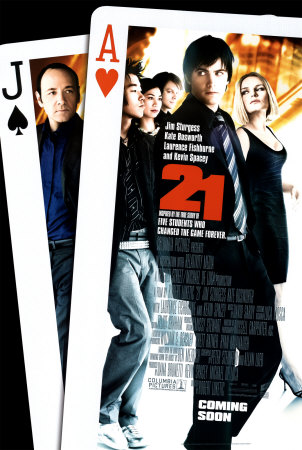
“21”

August 29, 2008

Tonight I finally saw the movie “21” with Kevin Spacey. I had heard a lot of things about the movie – mostly positive. It ended up being a good movie. The plot was well delivered, although at points it was predictable. The setting of Las Vegas was great as well – you can’t go wrong with Vegas!

What struck me was a line by Spacey’s character Mickey. After the group of MIT students had perfected a strategy, Mickey says to the main character, who is still a little nervous and stressed, “just let the car ride itself”. The idea that we need to enjoy the success of strategies that are working is something that I know I struggle with. It is not easy to “let the car ride itself” because I want control of it.

The reality is that the only control I have is merely an illusion of control.

Once you have done all that you can, sit back and enjoy the ride. It will be thrilling and sometimes scary and probably won’t end up how you thought. However, you will have stories and memories that would not have existed if you had not tried. Each moment we are creating experiences and memories that have not existed before. Instead of letting them happen, take part in the creation of those experiences – take part in creating your future!

Archaic Furniture

August 28, 2008

In Dee Hock’s, Birth of the Chaordic Age, an intriguing book, he mentions that:

“The most difficult part [of forming a chaordic organization] is to understand and get beyond the origin and nature of our current concepts of organizations; to set them aside in order to make space for new and different thoughts. Every mind is a room filled with archaic furniture. It must be moved about or cleared away  before anything new can enter. This means ruthless confrontation of the many things we know that are no longer so.”

This is such a profound and illuminating idea. Even scripture, with the parables of Jesus, compares our bodies as temples and houses. Being aware that something needs to be done is the first step, but then the moving or removal of mental furniture begins the real process of transformation. As Dee says later, a purpose must be agreed upon to direct the renovation. This purpose, both personal and professionally, has incredible importance in the “next steps” we take. It’s not something we spend five minutes on and then move – instead it can take much longer. Like other things in life it also is not static. There will be times when it will need reevaluating as well. This process is ongoing without ever arriving at a destination, but the result is a life fully lived and, as Jesus said, “more abundant”.

Personal Platform

August 27, 2008

We are in the election season in the United States. This means that we have primarily two parties, who each have a nominee for President of the United States. The way we know what these nominees believe and what they plan to do is by their “platform”. In each acceptance speech the nominees will list each “plank” of their platform. Subsequently, they will go all over the country and try to explain the differences between them and their opponent.

We are all used to this during election seasons, but what about yourself, what is your Personal Platform? What are the things that make you tick and cause your emotions to soar? Have you ever thought about writing those things down? Once something is written and articulated it gives you a piece of solid ground – your ground – on which to stand.

When you hear a speech, you know when someone is speaking from a paper or from their heart. Learn to live your life from your heart. Only then can the true You shine forth unabated by the filters of others.

Be clear and concrete and state your platform in vivid, unequivocal terms that will inspire and motivate others. Then read it out loud to yourself. See if you don’t feel a bit better and the future a bit clearer!

Emotional Intelligence

August 25, 2008

No, this is not a review of Daniel Goleman’s book Emotional Intelligence. The book is a great one that brought to the forefront the importance of emotional intelligence in the work place. His later book Social Intelligence is a few books down in my “Need to Read” stack, so you will be hearing about it in a future post. You can read his blog here.

This look at emotion comes from a meeting the staff had with Transformational Architect, Ron Martoia. During several hours the concept distilled the most was that emotional health in relationships is far more important than technical skills, knowledge, talent and ability to success in a working environment. The level to which emotion plays a part in interactions and the decision-making process is astounding. The way we continually do the same things emotionally expecting different results is equally as astounding.

Thankfully, we are not stuck in an emotional mud-bank. We each have what we need to cause personal and professional momentum to increase and, in turn, to increase the positive momentum of any organization we are a part of. Far more can be said than I would want to post, but the key is that whatever emotional position you are in now, you are not destined to stay there. You do have a future to be written that contains emotions full of health that help to propel you toward a great preferred future that you write.

If you have some specific questions about this topic, ask and we’ll see where it goes!

How?

August 16, 2008

Normally I wait until I’ve completed a book to comment on it, however Peter Block’s “The Answer to How is Yes” has got my mind on overdrive – and I’ve just passed the first chapter. He suggests that the question “How?” could be more of an obstacle rather than a help to an end. He uses “How?” as a symbol because it is the most frequently asked question following critical conversations about changing directions in our jobs and lives. Coming to the decision that something should be done is often easy. The raising of the question, “How?” inevitably leads to a halt in progress until we have some perceived certainty.

One of the best observations I’ve read yet is when Peter says that, “if we were really committed to the pursuit of what matters, we might well be served to hold a moratorium on the question ‘How?’…If we could agree that for six months we would not ask ‘How?’, something in our lives…might shift for the better. It would refocus our attention on deciding what is the right question, rather than what is the right answer. It would force us to act as if we already knew how – we just have to figure out what is worth doing.”

What is keeping you from pursuing something that has captivated your mind? Removing the question “How?” from the conversation leaves us with only a decision to decide what matters most. Think about your life and after evaluating what matters most, make it a priority to take the first step toward seeing that “thing” happen.