In the last couple of days, my counter said that over a hundred of you guys have visited. I still have the book, Wild Goose Chase, to give away. Just post your idea to impact the world in the comments section and we’ll pick and give the book away. More importantly, we will begin a conversation about joining together and “doing” something.
Archive for the ‘Books I’m Reading’ category
More Wild Goose
August 15, 2008Wild Goose Chase
August 13, 2008
What has to count as one of the best recent examples of things coinciding has to be my wife handing me my copy of Wild Goose Chase at around 8pm last night. I had come home and had thought about the book, but had let the thought go.
I had promised myself that I would read the book when it came in, so when I was handed the package I knew that my current reading would stop and Wild Goose would begin. Little did I know that by 1:30am I would have devoured the book and had some major epiphanies of my own.
Now to the actual review:

I had previously held up In a Pit with a Lion on a Snowy Day as one of my favorite books – especially books to give to people. In a Pit has been eclipsed by Wild Goose Chase, Mark Batterson’s second book. The greatest theme of the book is the paradox between a caged and wild animal. The caged animal is safe, fed, well taken care of; the wild animal is in danger, has to find food and is out in the elements. The question is – “Which one is really living?”
Then Mark states one simple wonder, “I wonder if churches do to people what zoos do to animals.” From then on we are catapulted into a no-holds-barred quest for the life that Christ has really offered us. His thoughts on the story of Peter’s denial and restoration in Chapter Five are worth the price of the book alone. His emphasis on playing offense instead of defense with your life has made my own mind reel and re-examine some of my routine “plays”.
The book as a whole wields a blow to the modern constructed “inverted christianity” we are familiar with and breaks through to a “responsible irresponsibility” that needs to define more people who present themselves as Christ followers. If a fraction of the people who read the book actually do what is presented, we will see a major shift in both the practice and possibility of the Church.
The book is out in stores on August 19th. Check out www.chasethegoose.com and get Mark’s 10 Steps to Setting Life Goals. You can purchase the book by going to www.amazon.com, www.barnesandnoble.com, www.borders.com, and www.cbd.com. This is one book you’ll want to buy 2 copies.
SIDENOTE: A major theme in the book is having big, huge, audacious goals and changing the world. I have a copy of Wild Goose Chase to give away and would like you to tell me what your big, huge, audacious goals for changing the world are. We’ll have a drawing and send the book to the winner, but we’ll also come together and do some open source global aid work and make some of our goals a reality – how ’bout that!
Wild Goose Chase
August 7, 2008I forgot to mention that I’ll also be getting a copy of the book to give away to you guys. How cool is that? Speaking of cool, what about tomorrow is 08/08/08.
Wild Goose Chase
August 5, 2008Just got a confirmation email about reviewing Mark Batterson’s new book, Wild Goose Chase. It should be in in a few days and I’ll read it and post about it – should be great. His last book, In a Pit with a Lion on a Snowy Day was by far, a book I’ll refer back to again.
New Mark Batterson Book
August 1, 2008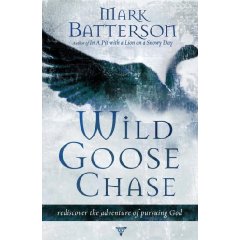
Got an email about a week ago asking for people to do a review of Mark’s new book due out August 19th, Wild Goose Chase. His last book, In a Pit, With a Lion on a Snowy Day, is one of those books that I find myself giving out to people constantly. Mark’s style, both in writing and in person is at once familiar and straightforward. He has the ability to immediately build a rapport with an audience so that the discussion can move deeper.
Hopefully in the next few weeks I’ll be able to review the book and let you guys know what it’s all about…Peace.
Book – The Intention Experiment
July 29, 2008I wrote about this book several months ago. It was the sort of book that I needed to read, then set aside and then read again. I finished the book during our vacation last week and had to comment on it.
Some of the subject matter is both intriguing and disturbing. The author posits some radical thoughts about the very act of thinking and the thoughts influence on the world around it. 
Definitely for the brave of heart, I found myself at times putting the book down and verbally asking questions out loud…to no one in particular. This book provoked my thinking and stoked the intensity of my belief in the incredible possibilities in human development.
“The Intention Experiment” takes you through plausible, though detailed, studies and experiments on the power of the humnan mind and spirit. In the end you are invited to continue the “experiment” yourself and interact with an online community of people and experience the power of intention personally.
Though I do not hold to all the author describes and concludes, I do think the subject matter is of importance to those who desire to see the interconnectedness of the mind and the spirit.
Small and Simple
June 26, 2008John Maeda is a genius. One of the most enlightening things I’ve read in a while is his idea concerning small and large items and our expectations about something big or something small.
When we find that something small exceeds our expectations we are amazed and will likely say, “I can’t believe all of that came out of such a small thing!” However, when something large exceeds our expectations, our sense of awe is considerably lower. John says, “The smaller the object, the more forgiving we can be when it misbehaves.”
Something that is larger than us demands a rightful respect, but something small deserves our pity. The science of making an object appear fragile is a skill that has been practiced for ages in art. The iPod is a singularly great example of something appearing fragile but exceeding our expectations based on size.
“Pity”, says John, “gives way to respect when much more value is delivered than originally expected.” This is especially true when, through technology, we can hide functionality within simplistic design.
There is even more. When an object is small and simple and functionality is hidden for the owner to manage the items complexity, the object must also convey an embodiment of value.
The combination of these three attributes creates a unique end result. It can bring us to the place where how the things we own feel actually changes how we feel.
John says it best when he says, “Lessen what you can and conceal everything else without losing the sense of inherent value.”
Reduction
June 25, 2008I’m loving the book, “The Art of Simplicity” by John Maeda. The first sentence of the book says, “The easiest way to simplify a system is to remove functionality.” He goes on to use the DVD player as an example. We really only need one button – play, but there are some who would like more, maybe to go back or go forward, still others would like more features.
The balance between simplicity and complexity is the basic question. How simple can it be and how complex does it have to be?
“The simplest way to achieve simplicity is through thoughtful reduction.” When you remove something, just think about it before you do it.
I am thinking about this in terms of life and church. How do we balance simplicity and complexity in those venues? Last week I wrote about the struggle between personal and professional vision. If we continue to add and add more and more we will soon drown in our own “vision”. There has to be a give and take if we are to “thoughtfully reduce”. This concept of reduction is John’s first of ten laws dealing with issues related to simplicity.
I leave you with one more thought coming from page two. When faced with the need to reduce we have to deal with the problem of deciding what lives and what dies. John says that these decisions do not come easy to us because we are not trained to be despots. Our default is to let what is living live. Inevitably we would allow all functionality to stay if we could.
What does it mean to improve?
June 20, 2008As a staff we have been to many conferences at or about Northpoint Community Church in Atlanta. During one of these [DRIVE Conference 2005], they shared that the momentum in an organization increases by either “new, improved or improving” ideas/facilities/volunteers/programs/etc.
This is a great idea, and one that continues to be a benchmark at Lifepoint when we evaluate whether to add to or subtract from some aspect of the church.
But what does it mean to improve? We can begin to think that to improve a program/ministry we need to add something to it. John Maeda, a favorite author/artist of mine in his book The Laws of Simplicity, explores in detail the notion of “improved” meaning to add on. In contrast he posits that to “improve” many times requires us to simplify and take away.
As you look at your life today, think of how you can improve one area by subtraction instead of addition.

 christopherhildreth